
TL;DR

Get cleaning gear delivered free with Prime
- Fast, free delivery on millions of items
- Prime Video, Amazon Music and more included
- Member-only deals all year
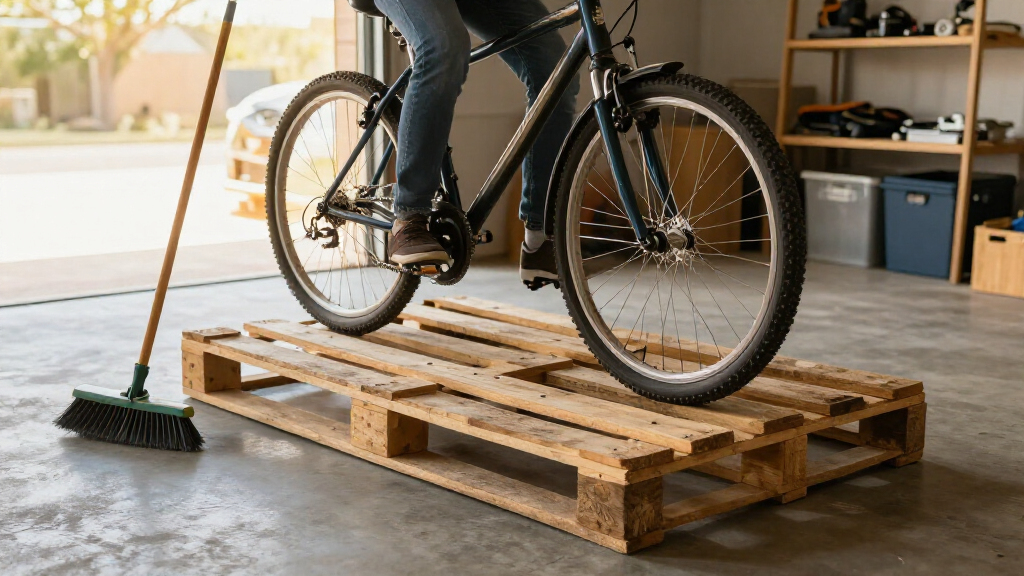
A Hunker report outlines a DIY garage bike rack made by cutting an old wood pallet lengthwise and repositioning its slats to hold bike tires. The basic floor rack is intended for bikes with kickstands or training wheels; bikes without them need added upright support and bracing.
A Hunker report describes how a YouTube creator turned a discarded wood pallet into a garage bike rack by cutting it lengthwise and repositioning its slats to form tire slots. The project offers a way to organize several bikes in a compact floor space, though bikes without kickstands or training wheels require additional upright support.
The basic design begins with an old pallet cut roughly in half lengthwise, close to one side of its center support. This leaves a narrower base and may preserve the other half for use in a supported upright version. The creator then removes and shifts deck slats to make openings sized for bike tires. Hunker says the slots should leave about a quarter of an inch of wiggle room: enough to insert a tire without forcing it, but not so much that the wheel can move or tip.
The slats can be reattached with pallet nails if they are in usable condition, or with wood screws if nails are missing or damaged. The report says the example pallet held five bikes, using a slat on each side of each tire, but the number of spaces depends on the pallet’s dimensions and the bikes being stored. It recommends sanding the finished rack to reduce splinter risk. Sealing or finishing the wood is optional, and families may label spaces to help keep the garage organized.
For bikes that cannot remain upright on their own, the report describes a more involved L-shaped rack based on a second tutorial from YouTuber Your Own Adventure. That version uses the pallet’s remaining section as a vertical tire support, with added 2-by-4 lumber at the base, brackets joining the upright to the base, and diagonal supports made from pallet slats. The slats on the upright must line up with the tire slots below.
A Low-Cost Way to Park Family Bikes
The project addresses a familiar garage problem: bikes can occupy a broad, disorganized area when they have no designated parking spaces. A row of tire slots can give each bike a fixed place on the floor, making it easier to return bikes after use and keeping them grouped rather than scattered. The design also makes use of pallet wood that might otherwise go unused.
The limits matter as much as the appeal. The simple rack is suited to bikes that can stand with a kickstand or training wheels; it is not described as a universal freestanding holder. The upright version adds materials and assembly steps, and the report does not provide load testing or a stated weight rating. Readers should treat it as a DIY storage idea, not as a tested commercial rack.
Products Worth Considering

Ring Floodlight Cam Wired Plus, 1080p HD Outdoor Security Camera with Motion-Activated Floodlights, 4-Pack, White

Ring Outdoor Cam 4K Plus Battery Security Camera, 3-Pack, White

Philips Hue Festavia Globe Outdoor String Lights, 32 Bulbs, 91 ft
As an affiliate, we earn on qualifying purchases.
Two Versions for Different Bikes
The Hunker report draws on a video by YouTube user This Dad Goes to 11 for the basic pallet rack. Its approach is to narrow the pallet, rearrange the top boards, and create a row of slots that hold wheels. The concept depends on the pallet’s existing frame and on adjusting the spacing for the bicycles at hand.
For bikes that need help staying upright, Hunker points to a separate tutorial by Your Own Adventure. That version uses the leftover pallet section as a vertical support and reinforces the base with lumber and brackets. The two approaches are related, but the second is not simply the basic rack unchanged: it calls for additional structural pieces and a careful match between the upper and lower tire slots.
“about a quarter of an inch”
— Hunker, summarizing the basic design
Fit and Strength Depend on the Build
The source does not give the pallet’s dimensions, wood condition, bike weights, or a tested capacity. It also does not establish that every pallet is suitable for reuse. The number of bikes a rack can hold and the fit of its tire slots will vary with the pallet and the bicycles. The report provides no independent safety testing, long-term durability results, or detailed instructions for anchoring the upright version. Anyone adapting the design will need to check the wood, fasteners, fit, and stability of their own rack before storing bikes on it.
Measure Bikes Before Cutting
The practical next step is to measure the bikes and inspect the pallet before making cuts. Plan the tire-slot spacing around the actual wheels, then check that the assembled base sits steadily on the garage floor. Sand rough edges and confirm that slats and fasteners are secure. If building the upright version, line up its slots with the base and brace the joint with suitable brackets and diagonal supports. The source gives no later testing or follow-up findings, so the result depends on the builder’s materials and assembly.
Key Questions
How many bikes can a pallet rack hold?
Hunker reports that the example pallet accommodated five bikes. Capacity varies with pallet size, slot spacing, and the bikes being stored; five should not be treated as a standard rating.
Can the basic rack hold bikes without kickstands?
The report says the floor-only design suits bikes with kickstands or training wheels. Bikes without either may need the added upright support and bracing shown in the separate tutorial.
How much space should there be around each tire?
The report suggests about a quarter of an inch of wiggle room so a tire can slide into its slot without jamming, while limiting movement. Check the fit with the actual bike tires.
Does the wood need to be sealed?
Hunker describes finishing or sealing as optional, depending on preference and expected wear. It recommends sanding the rack to reduce splinters, especially if the pallet is rough.
Source: rss