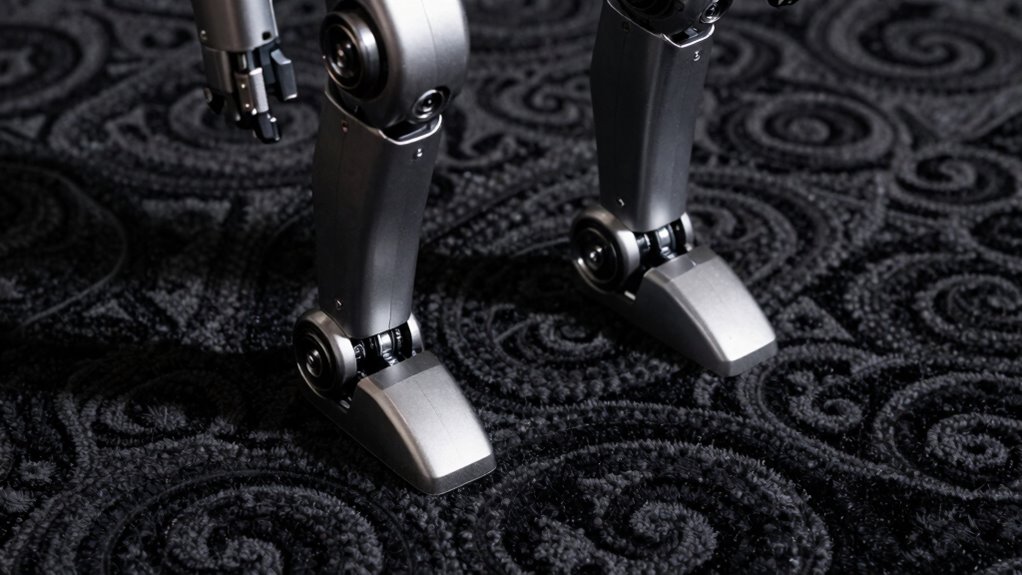

Dark rugs trick robot vacuum cliff sensors because these sensors rely on reflected infrared or laser signals to detect edges. Dark surfaces absorb or reduce the reflection of these signals, making the sensors interpret the rug as a drop or ledge. This causes the robot to stop or change direction unexpectedly. If you want to understand why this happens and how to prevent it, keep exploring the details behind sensor behavior and solutions.
Key Takeaways
- Dark rugs absorb infrared or laser signals, reducing reflection and causing sensors to misinterpret the surface as a drop or ledge.
- Cliff sensors are designed to detect edges, not surface color, leading to false positives on dark-colored rugs.
- Variations in surface reflectivity impact sensor accuracy, especially with dark or black materials.
- Advanced robots use multiple sensors and algorithms to better differentiate between actual drops and dark surfaces.
- The reflectivity properties of dark rugs can trigger false alarms, prompting robots to stop or reroute unnecessarily.
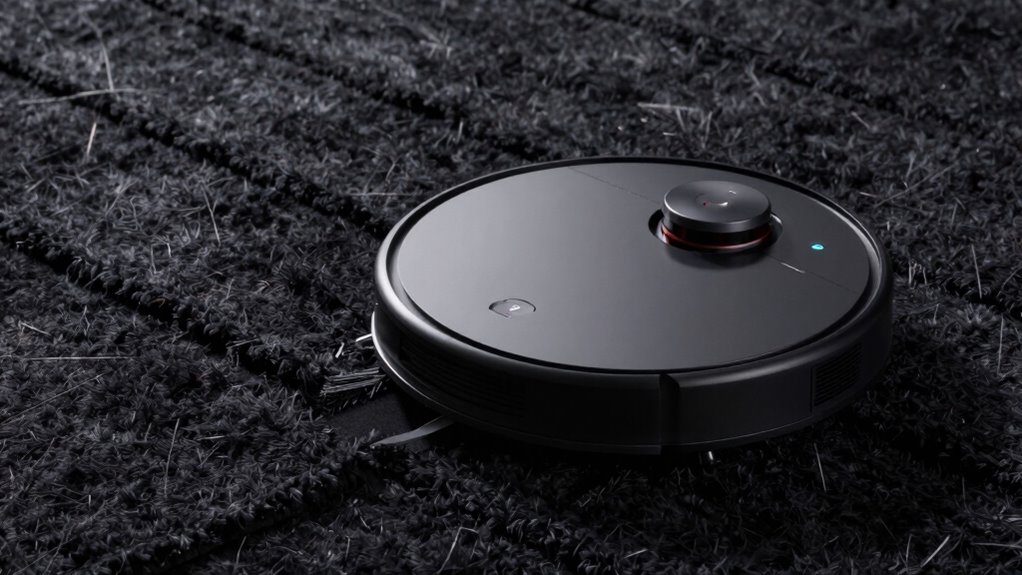
Dark rugs can pose a significant challenge for robot vacuum cleaners because their sensors often struggle to distinguish the edge of the rug from the surrounding floor. This issue mainly arises from how these devices perform robot navigation and surface detection. Most robot vacuums rely on cliff sensors—infrared or laser-based sensors positioned at the front or sides—to detect sudden changes in surface height or edges, preventing them from falling down stairs or off ledges. When these sensors detect a drop, they signal the robot to stop or change direction, helping it navigate safely around your home.
Dark rugs can confuse robot vacuum sensors, causing stops and reroutes due to difficulty detecting edges.
However, dark rugs can confuse these sensors because of their surface properties. The sensors work by emitting infrared signals or laser beams, which are reflected back to the robot to interpret the surrounding environment. When a rug is dark or black, it absorbs much of the infrared light instead of reflecting it. As a result, the sensors interpret the dark surface as a sudden drop or a ledge. The robot’s surface detection system, which is designed to identify edges, perceives the dark rug as a cliff or staircase. Consequently, the robot halts or reroutes, unable to proceed onto the rug, even if the surface is flat and safe to clean.
This behavior affects your robot’s efficiency because it prevents thorough cleaning of dark rugs. Instead of smoothly moving onto the surface, the robot might repeatedly stop at the edge, sensing a fall where none exists. Some newer models attempt to mitigate this issue through advanced robot navigation algorithms that incorporate multiple sensors, such as cameras or ultrasonic sensors, to better interpret the environment. These systems can sometimes differentiate between actual drops and dark surfaces by analyzing patterns, textures, or the way the sensors reflect light. Additionally, understanding the surface detection limitations** of cliff sensors can help you adjust your cleaning setup or choose a robot with more sophisticated navigation systems. Recognizing the sensor reflection properties of different surfaces can also aid in troubleshooting and optimizing your robot’s performance. Furthermore, some models incorporate multi-sensor navigation**, which enhances their ability to distinguish between real drops and dark surfaces.
Being aware of lighting conditions and how they influence sensor reflection can further improve your robot’s ability to navigate effectively around dark rugs. Despite these advancements, many robots still rely heavily on their cliff sensors for safety, especially in homes with dark-colored flooring or rugs. If you notice your vacuum frequently stops at dark rugs, it’s often because of surface detection limitations. To improve the situation, you can try placing a physical barrier or edge strip around the rug or use a robot model equipped with more sophisticated navigation systems. Understanding how these sensors work helps you anticipate and troubleshoot issues, ensuring your robot can clean effectively without unnecessary interruptions. Ultimately, recognizing that dark rugs interfere with cliff sensors allows you to make smarter choices about your vacuum’s placement and settings, helping it navigate your home smoothly.

Goodsby Replacement Cliff Drop Infrared Side Sensors for Shark IQ Robot Vacuums RV1001AE RV912S RV913S RV1000S QR1000SG AV1002AE AV1010AE AV911S QR1000SB UR1000SR UR1005AE RV1101ARUS UR1105ARUS
- Compatibility: Fits specific Shark IQ Robot models
- Model Check Reminder: Verify your vacuum model before ordering
- Compatibility Notice: Not compatible with 7xx, 8xx, 20xx series
As an affiliate, we earn on qualifying purchases.
As an affiliate, we earn on qualifying purchases.
Frequently Asked Questions
Can Changing the Rug Color Prevent Cliff Sensor Triggers?
Changing the rug color can help prevent cliff sensor triggers if you choose a shade with low contrast to the surrounding floor. Opt for colors that blend in, reducing the surface’s contrast and making it less likely to trigger. Additionally, consider the surface texture; smoother, uniform textures are less likely to confuse the sensor. By adjusting both color contrast and surface texture, you can minimize false cliff detections and improve your robot’s navigation.
Are Certain Robot Models More Prone to Dark Rug Issues?
Yes, some robot models are more prone to dark rug issues because their sensor technology struggles with certain surface colors. Robots with less advanced navigation systems or older sensor technology often misinterpret dark surfaces as cliffs, causing navigation problems. If you have a model known for these issues, you might consider upgrading to a robot with more sophisticated sensors, which improves overall navigation and helps prevent false cliff detections caused by dark rugs.
How Do Cliff Sensors Differentiate Between Rugs and Stairs?
Cliff sensors differentiate between rugs and stairs by analyzing surface reflectivity through sensor calibration. Rugs, especially dark ones, often reflect less light, making the sensors mistake them for drops. Stairs, however, usually have a consistent edge that sensors detect reliably. Proper calibration helps your robot distinguish surfaces accurately, reducing false alarms. Adjusting sensitivity settings can also improve the robot’s ability to recognize safe surfaces versus dangerous drops.
Do Dark Rugs Affect Other Robot Sensors Besides Cliff Sensors?
Dark rugs can indeed affect other robot sensors, not just cliff sensors. Think of color contrast as a spotlight, highlighting differences that may confuse your robot. When rugs are dark, their contrast with lighter floors can overwhelm the sensor sensitivity, causing false readings. This might make your robot slow down or stop unexpectedly, mistaking the rug for an obstacle or drop-off. Adjusting sensor sensitivity or adding boundary markers can help prevent these issues.
Is There a Way to Recalibrate Cliff Sensors for Dark Surfaces?
Yes, you can recalibrate your robot’s cliff sensors for dark surfaces. To do this, access the sensor calibration mode in your robot’s settings, then follow the prompts to adjust for rug color. This process helps your robot better distinguish between actual edges and dark rugs, preventing false cliff detections. Regular recalibration guarantees your robot navigates smoothly, especially on surfaces with varying colors and textures.
Goodsby Replacement Cliff Drop Infrared Side Sensors for Shark IQ Robot Vacuums RV1001AE RV912S RV913S RV1000S QR1000SG AV1002AE AV1010AE AV911S QR1000SB UR1000SR UR1005AE RV1101ARUS UR1105ARUS
- Compatibility: Fits specific Shark IQ Robot models
- Model Check Reminder: Verify your vacuum model before ordering
- Compatibility Notice: Not compatible with 7xx, 8xx, 20xx series
As an affiliate, we earn on qualifying purchases.
As an affiliate, we earn on qualifying purchases.
Conclusion
Next time you see a robot suddenly stop on a dark rug, remember it’s likely sensing a cliff, not a drop. Imagine a robot vacuum in your living room mistaking the deep black rug for a staircase edge, pausing abruptly to avoid falling. This quick reaction highlights how dark surfaces can trick cliff sensors, causing unnecessary stops. Understanding this helps you optimize your robot’s environment, ensuring smoother navigation and fewer surprises for both you and your smart devices.
Goodsby Replacement Cliff Drop Infrared Side Sensors for Shark IQ Robot Vacuums RV1001AE RV912S RV913S RV1000S QR1000SG AV1002AE AV1010AE AV911S QR1000SB UR1000SR UR1005AE RV1101ARUS UR1105ARUS
- Compatibility: Fits specific Shark IQ Robot models
- Model Check Reminder: Verify your vacuum model before ordering
- Compatibility Notice: Not compatible with 7xx, 8xx, 20xx series
As an affiliate, we earn on qualifying purchases.
As an affiliate, we earn on qualifying purchases.
Goodsby Replacement Cliff Drop Infrared Side Sensors for Shark IQ Robot Vacuums RV1001AE RV912S RV913S RV1000S QR1000SG AV1002AE AV1010AE AV911S QR1000SB UR1000SR UR1005AE RV1101ARUS UR1105ARUS
- Compatibility: Fits specific Shark IQ Robot models
- Model Check Reminder: Verify your vacuum model before ordering
- Compatibility Notice: Not compatible with 7xx, 8xx, 20xx series
As an affiliate, we earn on qualifying purchases.
As an affiliate, we earn on qualifying purchases.