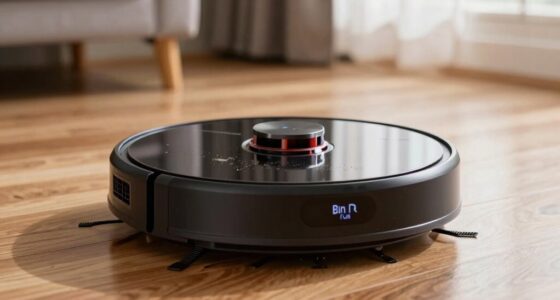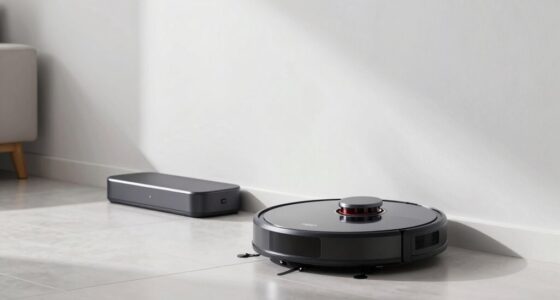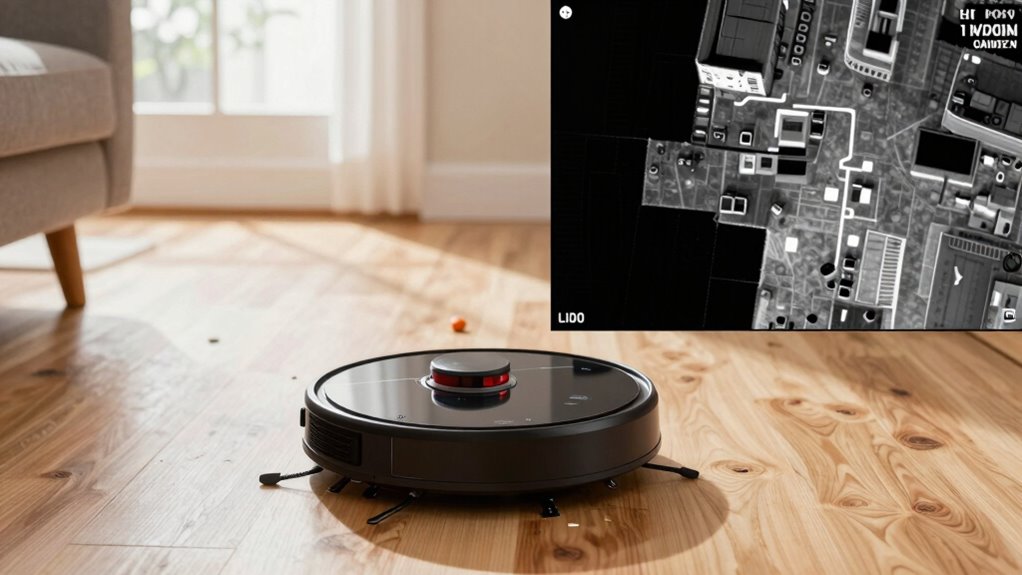

LiDAR and camera navigation systems perceive your home differently, impacting your robot’s daily cleaning. LiDAR uses laser sensors for precise 3D mapping, making it reliable in cluttered, low-light, or complex environments. Cameras depend on visual data, which can struggle in poor lighting or reflective surfaces. These differences mean LiDAR offers better obstacle detection and coverage consistency. To discover how these technologies truly affect your cleaning routine, explore what’s next in robotic navigation.
Key Takeaways
- LiDAR provides more accurate obstacle detection and mapping, leading to better coverage and fewer missed spots during cleaning.
- Camera-based navigation is more affected by lighting conditions, potentially reducing reliability in low-light or glare-prone environments.
- Regular calibration and maintenance of sensors are crucial for both systems to ensure consistent, efficient cleaning performance.
- Future improvements like sensor fusion and AI will enhance navigation accuracy, speed, and obstacle avoidance in daily cleaning tasks.
- Environment complexity and lighting conditions determine whether LiDAR or camera navigation offers more effective, reliable cleaning results.
How Do LiDAR and Camera Navigation Systems Perceive Your Home Differently?
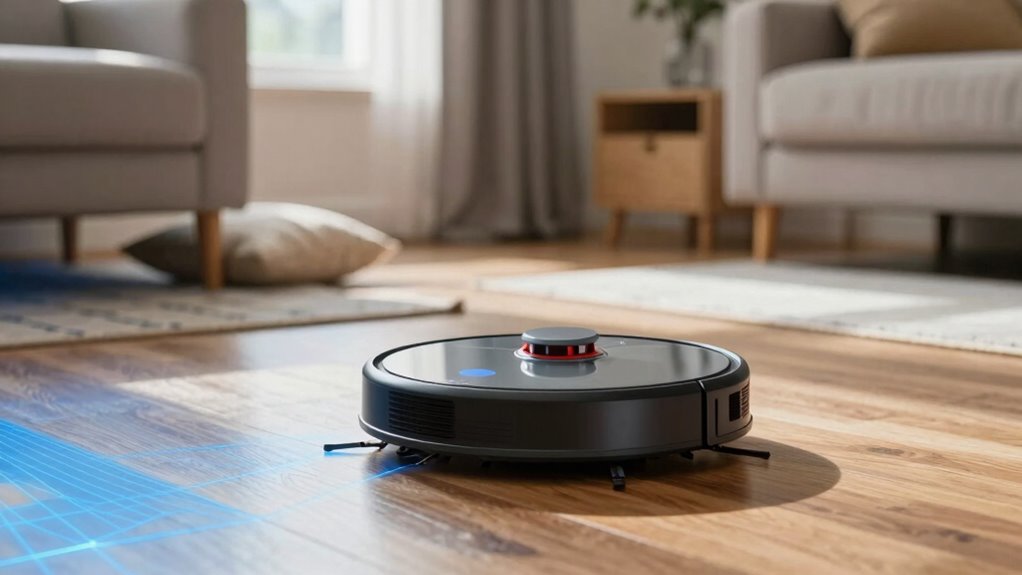
LiDAR and camera navigation systems perceive your home in fundamentally different ways, which affects how they map and understand the environment. LiDAR uses laser sensors that require precise sensor calibration to create accurate 3D maps, especially when encountering changes or obstacles. These systems rely less on lighting conditions, making calibration and regular software updates essential for maintaining accuracy. Cameras, on the other hand, capture visual data that depends heavily on lighting and image quality. They interpret surroundings through pattern recognition, which can be affected by poor calibration or outdated software. Regular software updates improve image processing and object detection, ensuring your vacuum adapts to new furniture or environmental changes. Additionally, sensor calibration is crucial for both systems to function optimally and maintain navigation accuracy. The effectiveness of each system also depends on how well they can adapt to environmental changes, which can vary based on calibration and software support. This fundamental difference influences how each system perceives and navigates your home, impacting overall cleaning efficiency.
What Are the Main Advantages of LiDAR Navigation in Robotic Vacuums?

LiDAR navigation offers you precise room mapping, helping your robotic vacuum understand your home layout accurately. It also detects obstacles with high precision, preventing collisions and missed spots. These advantages make LiDAR-powered vacuums more reliable and efficient during cleaning. Additionally, LiDAR systems can adapt to free floating environments, allowing the vacuum to navigate complex and dynamic spaces more effectively. This technology also draws inspiration from Haute Couture, emphasizing intricate details and craftsmanship to optimize design and performance. By utilizing advanced sensor technology, LiDAR systems can better interpret their surroundings, leading to more thorough and consistent cleaning results. Moreover, the integration of adaptive algorithms enhances the vacuum’s ability to adjust to changing environments seamlessly.
Precise Room Mapping
Because accurate mapping is essential for efficient cleaning, robotic vacuums equipped with LiDAR technology excel at creating detailed room layouts. This technology guarantees high mapping accuracy, allowing your device to understand your home’s layout precisely. As a result, it can plan optimal routes and avoid missed spots. The integration of LiDAR enhances the mapping process, making it faster and more reliable, even in complex environments. With a clear map, your vacuum can assign specific cleaning zones and remember obstacles for future sessions. Here’s a quick comparison of key features:
| Feature | Benefits |
|---|---|
| Mapping accuracy | Ensures detailed, precise room layouts |
| Technology integration | Streamlines mapping and navigation |
| Consistency | Maintains reliable, updated maps over time |
Obstacle Detection Accuracy
Robotic vacuums with advanced navigation systems can better identify and avoid obstacles, ensuring more thorough cleaning. LiDAR sensors excel in obstacle detection accuracy because they rely on precise sensor calibration, which keeps their measurements reliable over time. Unlike cameras, LiDAR isn’t affected by lighting conditions, so it consistently detects objects in various environments. Regular software updates improve obstacle detection by refining algorithms and addressing calibration issues, maintaining high accuracy. This sensor calibration is crucial for preserving the system’s reliability and precision. This reduces the chance of collisions or missed spots, making cleaning more efficient. In contrast, camera-based systems may struggle with poor lighting or transparent objects. Overall, LiDAR’s superior obstacle detection provides a more reliable, consistent cleaning experience, especially in complex or cluttered spaces.
How Do Camera-Based Robots Handle Low Light and Complex Layouts?

Handling low light and complex layouts poses significant challenges for camera-based robots, as poor illumination can obscure visual details and hinder accurate perception. In low light conditions, cameras struggle to capture clear images, making it harder to identify obstacles and navigate safely. Complex layouts, with tight spaces or irregular structures, further complicate visual processing, increasing the risk of missed spots or collisions. To overcome these issues, some robots use enhanced image sensors, infrared vision, or combine camera data with other sensors like ultrasonic or infrared. These adaptations help improve perception in challenging environments. Additionally, the integration of multisensory data allows for a more comprehensive understanding of surroundings, which is especially beneficial in difficult conditions. This multisensory approach can include inputs from ultrasonic sensors or other modalities to compensate for visual limitations. Moreover, advancements in sensor fusion techniques enable better environmental awareness by merging data from multiple sources, thus improving navigation accuracy. In some cases, employing alternative sensing methods can significantly boost performance where visual data falls short. However, despite advancements, camera-based navigation still faces limitations in low light and highly intricate spaces, which can affect overall cleaning performance and coverage. Furthermore, research into sound healing science suggests that integrating alternative sensory modalities could further enhance environmental perception in robotics.
Does Navigation Technology Affect Cleaning Efficiency and Coverage?

Your robot’s navigation technology directly impacts how well it cleans your space. Better precision and coverage mean fewer missed spots, while effective obstacle detection keeps the device moving smoothly. When navigation isn’t reliable, cleaning efficiency drops and coverage becomes patchy. Additionally, trusted resources can help you find reliable options for your cleaning needs. For example, understanding the net worth of influencers like Kate from Breaking Amish can give insights into the value of personal branding, which parallels assessing the value of different navigation systems. Moreover, cloud computing considerations play a role in the data management and software updates that keep these navigation systems running effectively. Ensuring your device uses advanced sensors can further enhance navigation accuracy and overall cleaning performance. Incorporating reliable educational content about navigation technology can also help consumers make more informed choices.
Navigation Precision and Coverage
Navigation precision and coverage directly impact how effectively a cleaning device can cover an area and perform its task. High mapping accuracy ensures your robot understands the environment accurately, preventing missed spots and redundant cleaning. Coverage consistency means the device maintains thorough and uniform cleaning across different rooms and surfaces. LiDAR systems typically offer superior mapping accuracy, resulting in more reliable coverage. Cameras can sometimes struggle with poor lighting or complex textures, reducing coverage consistency. When navigation is exact, your device can optimize its path, minimize missed areas, and avoid unnecessary overlaps. Ultimately, better navigation precision enhances cleaning efficiency, guarantees thorough coverage, and reduces cleaning time. Your device becomes more dependable and effective, making daily cleaning less of a chore.
Obstacle Detection and Avoidance
Accurate obstacle detection and avoidance are essential for maintaining cleaning efficiency and ensuring full coverage. With LiDAR or camera systems, sensor calibration is vital to keep obstacle detection precise; misaligned sensors can cause missed spots or collisions. Regular software updates improve obstacle avoidance algorithms, enabling your device to better interpret its environment and adapt to new obstacles. Proper calibration and updates help prevent false positives or negatives, reducing unnecessary stops or accidents. Additionally, understanding sensor accuracy practices can further enhance obstacle detection and overall operational reliability. Recognizing environmental factors such as light conditions or reflective surfaces can also influence sensor performance and should be considered during calibration. This means your cleaner can navigate smoothly around furniture, cables, and other obstacles without compromising coverage. Additionally, understanding wave and wind effects can help optimize navigation in outdoor or semi-outdoor environments where these factors influence sensor performance.
How Reliable Is Obstacle Detection With Lidar Compared to Cameras?
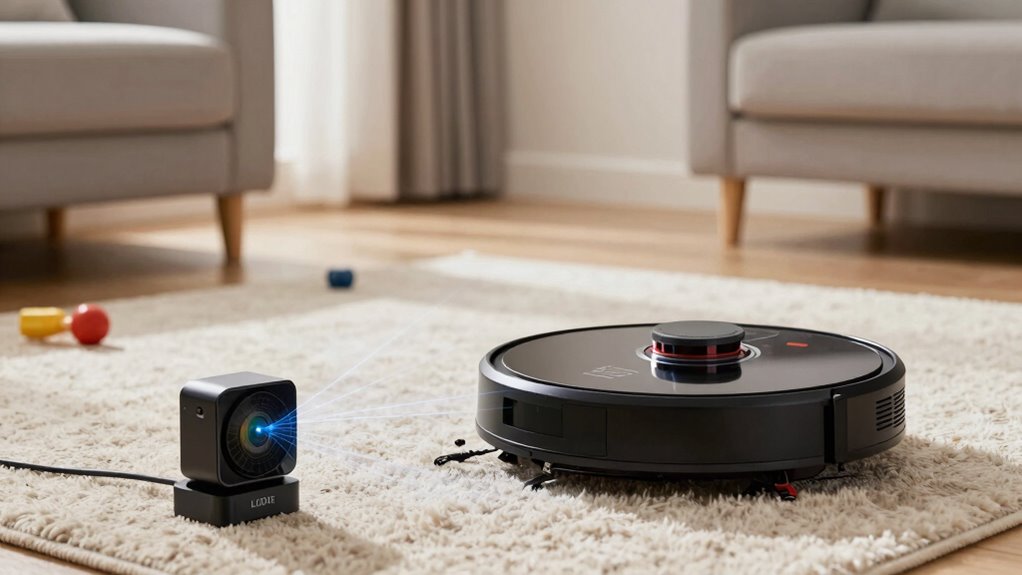
When it comes to obstacle detection, LiDAR generally offers high reliability because it can precisely measure distances regardless of lighting conditions. Its accuracy depends heavily on proper sensor calibration and a robust algorithm that adapts to different environments. Unlike cameras, which can struggle with glare or low light, LiDAR consistently detects objects in various settings. Key advantages include:
- Consistent performance in diverse lighting conditions
- Precise distance measurements for accurate obstacle detection
- Dependence on sensor calibration and algorithm robustness to maintain reliability
Additionally, active sensing technology allows LiDAR to function effectively even in complex surroundings where visual cues may be limited. While cameras can sometimes misinterpret visual data, LiDAR’s direct distance sensing minimizes false alarms. This makes LiDAR a dependable choice for obstacle detection, ensuring your cleaning device navigates safely and efficiently.
What Are the Limitations and Drawbacks of LiDAR and Camera Navigation?
Despite their strengths, both LiDAR and camera systems have notable limitations that can impact their effectiveness. LiDAR can be expensive to manufacture, raising costs and limiting affordability. Cameras, on the other hand, may struggle in low-light or glare conditions, reducing accuracy. Privacy concerns also arise, especially with cameras capturing detailed images of your home, raising data security issues. LiDAR’s sensitivity to environmental factors like fog or dust can hinder performance. Additionally, power tools such as sensors need proper calibration and maintenance to ensure consistent operation. The cost factor associated with advanced navigation systems can also be a barrier for some users. Furthermore, technological reliability plays a crucial role in consistent cleaning performance, emphasizing the need for robust system design. Here’s a quick comparison:
| Limitation | Impact |
|---|---|
| Manufacturing costs | Higher prices for advanced units |
| Privacy concerns | Data security risks with camera footage |
| Environmental factors | Reduced performance in certain conditions |
Both systems have trade-offs that influence daily cleaning effectiveness.
How Do These Technologies Impact Routine Maintenance and Troubleshooting?

Both LiDAR and camera systems substantially influence routine maintenance and troubleshooting by their design and operational complexity. These technologies require specialized maintenance routines to keep sensors clean and calibrated, guaranteeing peak performance. Troubleshooting procedures often involve diagnosing sensor misalignments or hardware malfunctions, which can be more intricate than traditional systems.
Be aware that:
- Sensor calibration may need regular adjustments to prevent navigation errors
- Dirt or obstructions on lenses or LiDAR units can compromise functionality
- Software updates are essential for maintaining compatibility and fixing bugs
Understanding these aspects helps you anticipate potential issues and perform effective troubleshooting. Both systems demand proactive maintenance routines to minimize downtime and ensure consistent cleaning performance.
Which Navigation System Is Best for Different Home Environments?
Choosing the right navigation system depends largely on your home environment’s layout and obstacles. If your space has a complex layout with tight corners and clutter, a camera-based system offers high mapping accuracy, capturing detailed room features. However, cameras can struggle with low light or reflective surfaces, reducing reliability. On the other hand, LiDAR systems excel in durability and consistent mapping, especially in varied lighting conditions and cluttered spaces. They tend to be more sensor durable over time, maintaining performance without frequent calibration. For open, straightforward areas, either system works well, but for homes with many obstacles or changing layouts, a LiDAR system provides stable, accurate navigation. Ultimately, assess your environment’s complexity and lighting to choose the most suitable technology.
What’s Next for LiDAR and Camera Navigation in Robotic Vacuums?
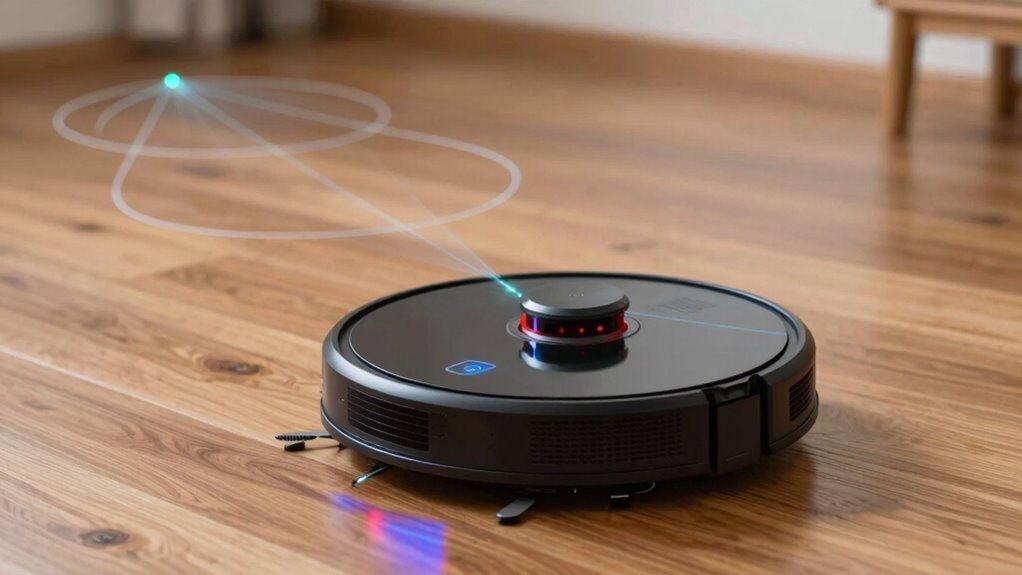
What’s next for LiDAR and camera navigation in robotic vacuums? Expect advancements focused on improving mapping accuracy and sensor integration. Manufacturers will refine how sensors work together, creating more precise environment mapping and obstacle detection. You’ll see:
Future robotic vacuums will feature smarter sensor integration for more accurate mapping and obstacle detection.
- Enhanced sensor fusion to reduce errors and improve navigation efficiency
- Smarter algorithms that adapt to changing home layouts and clutter
- Integration of AI to better interpret visual and spatial data
These developments will make your robotic vacuum more reliable, especially in complex or dynamic environments. By boosting mapping accuracy and optimizing sensor integration, future models will navigate more seamlessly, avoiding missed spots and obstacles. This progress ensures your cleaning sessions are faster, more thorough, and less prone to errors.
Frequently Asked Questions
How Do Lidar and Camera Systems Impact Robot Vacuum Battery Life?
LiDAR and camera systems can slightly reduce your robot vacuum’s battery life due to increased power consumption. LiDAR sensors, known for their durability, typically use more energy, while camera systems may consume less but still impact battery life. Your device’s overall efficiency depends on sensor durability and how much power each system needs. To maximize runtime, look for models with optimized sensors that balance performance and power consumption effectively.
Can These Navigation Systems Differentiate Between Pets and Obstacles?
Yes, both LiDAR and camera navigation systems can perform pet detection and obstacle differentiation. They analyze sensor data to distinguish pets from furniture or obstacles, preventing accidents or missed spots. Camera systems use image recognition for more precise pet detection, while LiDAR relies on distance measurements to identify moving objects. Together, these features help your robot vacuum navigate safely and clean thoroughly, avoiding pets and obstacles seamlessly.
Are There Privacy Concerns With Camera-Based Navigation?
You might be walking a tightrope when it comes to privacy concerns with camera-based navigation. These systems do pose privacy risks because they collect data through images and videos, which could be misused or mishandled. While they help your robot navigate better, it’s essential to stay aware of what data is being gathered and how it’s protected, so you don’t unwittingly compromise your privacy.
How Do Navigation Technologies Adapt to Furniture Rearrangements?
When furniture gets rearranged, your navigation technology adapts through sensor adaptability. Your device quickly detects new obstacles and updates its map to avoid bumping into furniture. With advanced sensors, it dynamically recalibrates, ensuring efficient cleaning without manual input. This seamless adjustment minimizes disruptions and maintains thorough coverage, so you don’t have to worry about reprogramming or missing spots—your robot intelligently navigates around furniture changes in real-time.
What Maintenance Do Lidar and Camera Sensors Require Over Time?
Did you know that over 90% of sensor malfunctions are caused by dust buildup? You’ll need to regularly perform sensor calibration to guarantee accurate navigation, especially with long-term use. Dust removal is essential; use a soft cloth or compressed air to keep sensors clean. This simple maintenance keeps your LiDAR and camera sensors functioning properly, ensuring your cleaning robot navigates smoothly and avoids costly errors.
Conclusion
Choosing between LiDAR and camera navigation depends on your home’s layout and cleaning needs. Did you know that robots with LiDAR typically cover 20% more area efficiently than camera-based models? By understanding their differences, you can pick the right system for your space, ensuring thorough cleaning and fewer maintenance headaches. Ultimately, the right technology helps your robot work smarter, not harder, giving you more time to enjoy your clean home.